Bing will be displaying holiday hours in real time for all holidays going forward.
The post Bing to Begin Displaying Holiday Hours for Local Businesses by @MattGSouthern appeared first on Search Engine Journal.

Bing will be displaying holiday hours in real time for all holidays going forward.
The post Bing to Begin Displaying Holiday Hours for Local Businesses by @MattGSouthern appeared first on Search Engine Journal.
Posted by randfish
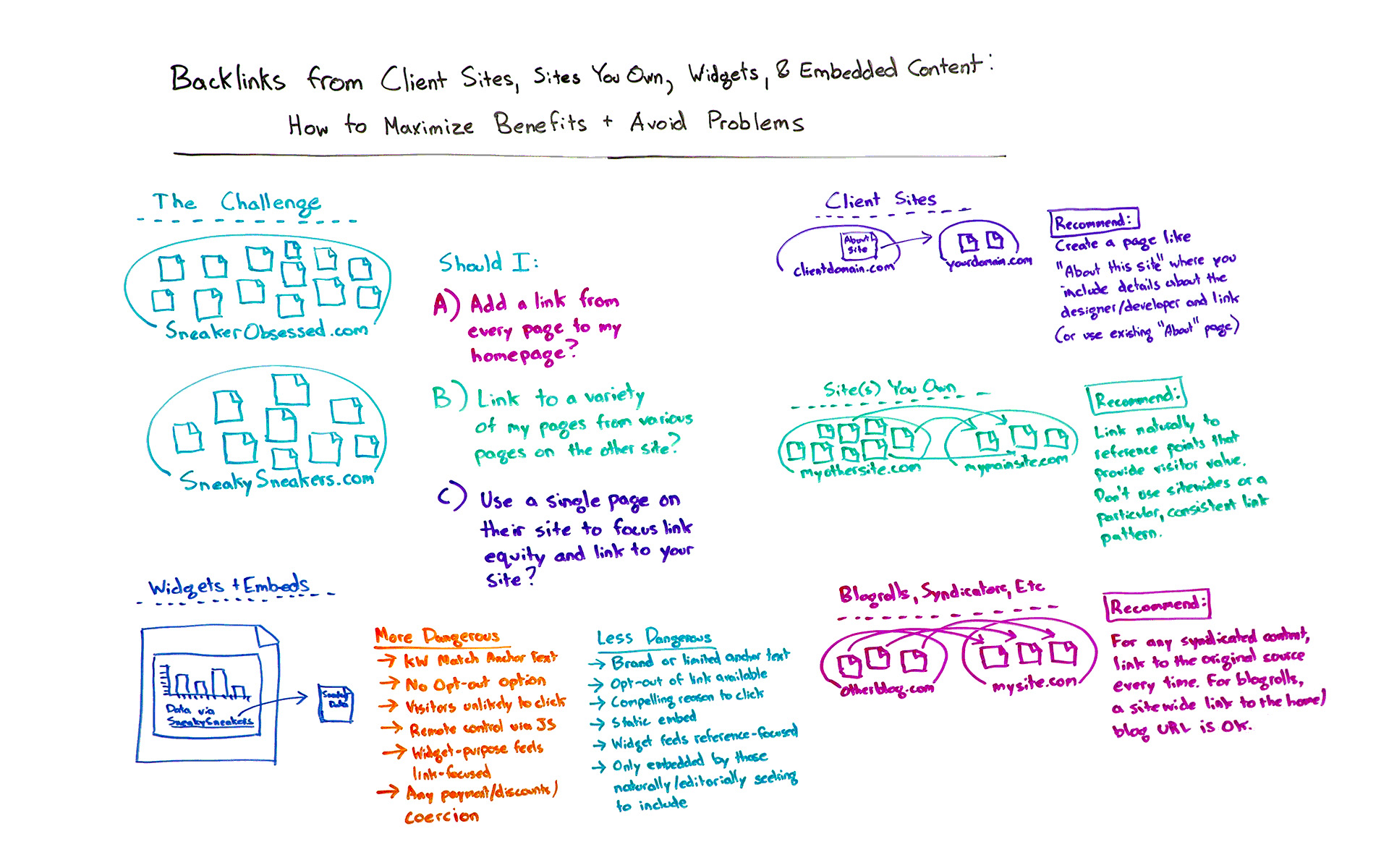
When it comes to certain kinds of backlinks, avoiding penalties can be a real gray area. How can you earn the benefits without gaining the scrutiny of Google? In this Whiteboard Friday, Rand will teach you which rules to follow to keep you safe and on the up-and-up, all while improving your link profile.
Click on the whiteboard image above to open a high-resolution version in a new tab!
Howdy, Moz fans, and welcome to another edition of Whiteboard Friday. This week, we're going to chat about a question we see a lot here at Moz, around what you should do with websites that you maybe design or build or do work for, your clients' websites if you're an agency or consultant, or a web designer or builder, sites that you own but are not your primary website, and widgets and embeds, blogrolls, all these kinds of things where you control the link infrastructure, or could control it, and should you.
I think one of the challenges here is to understand that many folks have recognized that, over the years, widgets, embeds, links from client websites have gotten other sites penalized, potentially even your sites penalized over the years, because you had all these links that you control pointing back to places, and to Google that can look really sketchy. So I want to talk through some best practices about how you can get link benefit and value from these places without getting yourself into trouble.
All right. The challenge here is let's say that I own sneakerobsessed.com, but it is not my primary website, or maybe it's a client's website. But I do own sneakysneakers.com, and I'm thinking to myself, "Gosh, you know the fact that I control, I have the login for the admin here, the site owner, or me, would be fine with linking from these pages to these pages. What should I do there? I don't want to get into trouble. But I would love to get some benefit, and I think that these links could help me. Should I:
A. Add a link from every page here to a bunch of pages here or to my homepage?
B. Should I link to a variety of my pages, like take a few of these and link them to my homepage, take a few others and link to some internal pages?
C. Should I use a single page on this website to link back to maybe my homepage?
The answer is kind of, it depends. It depends.
Anytime you're referencing other content you've created or things that you've done, or recognition that you have, or someone else from your organization, you would naturally link over here. That's the way you should play it, not with some specific process and checklist. Anything that matches a very standard pattern is going to be easily recognized by Google, and that can get you into trouble.
The only time you get into real trouble is if that blogroll is essentially just a paid manipulation. It's technically a blog network. It's not that you're being editorially endorsed by someone else. They're only linking to you because you're linking to them. You get into that reciprocity challenge. That's not to say you should never link to anyone who has you in their blogroll either. It's just that this has to look natural and editorial to Google, or you can get in trouble.
Syndicators, by the way, it's okay to link from every syndicated piece of content back to the original piece of content. In fact, that's the way it should be. If you do your own syndication, like I do sometimes on Medium, where I put up my blog posts that I've already put on moz.com/rand on medium.com/randfish, then you should have each of those link back to their original pieces, and that's just fine.
So the idea here is that you have this piece of content here that's being embedded from your site. So Sneaker Obsessed, maybe the guys there went to Sneaky Sneakers. They saw a data graph of Nike shoes versus Adidas shoes sales over the last 12 months, and they were like, "Oh, man. I really want to show that. That's awesome." In fact, there's a little "embed this graph onto your own website." So they took that, and they put it on there.
You get into more dangerous territory with this type of thing when in the link between here there's:
You're much less likely to have problems if you:
That will keep you safe.
Hopefully, you will not encounter these problems. I think if you follow these rules, you'll be in the safe zone, and you'll also be benefiting from the link value that these can provide. I look forward to your comments. We'll see you again next week for another edition of Whiteboard Friday. Take care.
Video transcription by Speechpad.com
Sign up for The Moz Top 10, a semimonthly mailer updating you on the top ten hottest pieces of SEO news, tips, and rad links uncovered by the Moz team. Think of it as your exclusive digest of stuff you don't have time to hunt down but want to read!
Posted by ronell-smith
Dr. Pete throwing down at MozCon 2015, flexin' in his retro Flash t-shirt
At MozCon 2015, Dr. Pete delivered a gem that perked up my ears when he discussed Google's featured snippets during his talk, "Surviving Google: SEO in 2020":
"Let's say you're No. 5 in a competitive query, and you're trying to get from No. 5 to No.1. That is incredibly difficult; that takes a lot of money, a lot of links, a lot of authority. You might be able to jump past No. 1 to No. 0 with this just by matching the question better. So it may actually be easier to get from No. 5 to No. 0 than it is to get from No. 5 to No. 1 ... Be a better match. Be a better answer to the question. It's good for users."
Something about those 98 words perked my ears up, especially the last two sentences.
Those words rolled around in my head for months, though their impact wouldn't be felt until even later, when I began to see how prevalent featured snippets had become.
More than a year later, I'm now more convinced than ever that most brands should be making the attainment of featured snippets a priority.
Why?
Try as they might, most sites don't stand a chance of making it to the No.1 position in the SERPs. And today, with so much priority given to ads at the top of the page, above the organic results - not to mention the fact that most people don't recognize ads from organic results - even those who do reach the coveted position have to feel as though they've secured a pyrrhic victory.
In the year-plus since the presentation, rich answers have grown significantly, as depicted by the graph below from Stone Temple Consulting:
And in the span, a number of teams and individuals have made it their charge to better decipher featured snippets, specifically regarding what seems to influence their presence for certain queries, what types of snippets there are, how to optimize your content to make it more likely that you receive one, and what Google is likely looking for when a snippet is ultimately featured.
(For in-depth background information on featured snippets, see the Related Content section at the bottom of the post.)
But not a whole lot has been written on how to keep featured snippets once your brand has one. This fact hit me like a ton of bricks during MozCon 2016, when I listened to Rob Bucci of GetStat during his presentation Taking the Top Spot: How to Earn More Featured Snippets.
This post, which is a wellspring of some comments Bucci shared near the end of his presentation, will be focused very narrowly on how to keep a Featured Snippet once your brand has been fortunate enough to receive one.
Before we dive into that aspect, let's briefly go over a few specifics, surrounding the nuts and bolts of featured snippets.
For your brand or any other, however, (a) featured snippets provide you with an easy opportunity to better compete against the competition, (b) can amount to a low-investment/high-reward opportunity, and (c) can give you a leg up on the competition.
One of the main reasons to attend conferences such as MozCon in person is the potential to hear a nugget of wisdom that would be missed in a recap blog, not properly conveyed in a tweet by an attendee, or glossed over when listening to the video after the event.
For example, Dr. Pete's quote from MozCon 2015 rang clear as a bell when I heard it while sitting in the audience, but I'm not sure I would have noticed it so readily had I simply watched the videos.
During the Q&A that followed Bucci's talk, he was asked about the real value of investing in featured snippets, a particular concern given that, in most cases, Google is serving up the content with very little benefit to the brand that houses it. (Unless the user clicks on the URL at the bottom of the content and visits the website.)
Bucci did far more than answer the question before him, however.
"Let's say I was [trying to teach someone] how to make toast. The snippet is, like, step 1 put the bread in the toaster; step 2, toast the bread; step 3, eat it, right? If I added a fourth or fifth step so that it was truncated in the snippet, i.e., they didn't get the full steps to make toast, people would be more likely to click on it to get the full results. Think about how you can optimize your snippets by making it so that you don't give away the entire farm in your snippet. They have to go through your website to get the information."
This tidbit got my attention for two reasons:
Image courtesy of Stone Temple Consulting, Google's Featured Snippets: Automated Continuous Improvement
By applying the logic in Bucci's quote, your brand can employ what I call next-level thinking.
Instead of simply thinking "How do I get a featured snippet?", think "How do I keep a featured snippet?" This is especially important since, as has been reported by STC, Bucci, and others, Google is likely using engagement metrics (e.g., clicks on the URL) as a factor in determining churn.
"By crafting your snippet content in a way that encourages people to click through to your site for the full detail, you can raise your CTR on that SERP," says Bucci. "That's the key thing."
As you can see from the result below, this result, drawn from the No.1 result on the page, is unlikely to warrant a click since all the needed information is right there for the taking.
However, in the result below, the web searcher will have to click the URL and visit the owner of the content's website to see the full list.

The important point to delivering a result that's churn-resistant, says Bucci, is to think strategically.
"The biggest recommendation I made that I think people are only now starting to pay attention to how to strategically use formatting to A) win snippets and B) create great user experiences on the SERP. People were just focused on getting any old snippet, but my advice was that they should look at the query space and measure the most common snippet formats. From there, they should optimize their snippets to match those formats, because Google is clearly indicating that they want to use those formats within the give."
Bucci made a great point, highlighting how we should pay attention to the formatting and content types - not simply the queries - that consistently show up as featured snippets. This, he says, amounts to Google telling us what they're looking to reward.
It's exciting to see brands jump into the fray, beginning to think seriously about featured snippets and how the organic elements can impact their brands.
Dr. Pete, who has remained a passionate advocate for brands taking a serious look at how to get and keep featured snippets, says it's essential that brands build their attainment into their overall process, not use it as a one-off tactic.
"I think the first step is to think in terms of questions, and build part of your keyword research around that. In natural language search, questions are increasingly common. Which questions are part of your conversion path? Don't discount them just because they're early in the funnel or part of the research phase. Find out if those questions are showing snippets and then think about ways to use those snippets as a teaser to draw people into your content and, hopefully, your funnel. Once you're ranking on page 1, it's about shaping your content to better answer the question. I think it helps to take an 'inverted pyramid' approach - lead with your most compelling question and a summary of your content, and then dive into the details. This makes for better snippets and grabs short attention spans."
One of the best ways to get started with featured snippets is by taking a step-by-step approach so that everyone on the team knows what you're going after, why, and its likely impact to the brand.
The graphic below is as specific and as detailed as you need to be to get started.

Image source: Stone Temple Consulting
Remember, though, like all aspects of online marketing, the endeavor will be iterative. What you gain, you might lose. But the process is invaluable.
Hopefully, I've shared at least one small tidbit of information that has you excited about adding the attainment of featured snippets to your content marketing strategy.
For those of you who might be on the fence, wondering if the potential reward warrants the expense, Dr. Pete's words should nudge you in the right direction.
"I think content that answers questions is naturally compelling, which is what I like about optimizing for featured snippets ... Content that answers questions succinctly provides real value and builds a base of value for your visitors, regardless of where they arrive from. Even if you lose the featured snippet, you've built something useful."
It bears repeating:
Dr. Pete continued:
"Think of featured snippets as much like organic ranking - they aren't something Google awards you and then lets you keep until a new winner comes along. Featured snippets are generated by the algorithm in real time, just like organic rankings. You have to keep competing for them."
Has your brand experimented with featured snippets? If so, what's been the result?
Remember, Moz Pro will help you find and track featured snippets, as well as identify opportunities for acquiring them!
Sign up for The Moz Top 10, a semimonthly mailer updating you on the top ten hottest pieces of SEO news, tips, and rad links uncovered by the Moz team. Think of it as your exclusive digest of stuff you don't have time to hunt down but want to read!
As the holiday season approaches, marketers are looking for ways to increase profits, drive traffic, and improve business-to-business relationships. One of the best ways to do this is through co-marketing, or in other words, having two companies collaborate in order to get the most out of a campaign.
The post The Beginner's Guide to Putting a Co-Marketing Strategy in Place This Holiday Season by @seocompanymiami appeared first on Search Engine Journal.

Last week Metro Bank became the first financial institution to offer a gender neutral option for both its staff and customers.
The move was made in response to an interview with a Scottish teenager who couldn't open a bank account because they didn't identify as either male or female, which was a required question on the form.

Image from Buzzfeed.
Metro Bank now offer a title of 'Mx' and a gender option of 'nonbinary' in addition to the standard 'male' or 'female' options. While the response to the change has been polarised, these changes are something that will impact marketing data and how we use it going forward.
We seem to have accepted that ethnicity, and more importantly how people identify themselves is varied, so why is gender different? Metro Bank may be leading the way here, but I can't imagine it will be long before other large organisations follow, particularly with the various anti-discrimination acts in place.
 So what does this mean for marketing?
When developers are dealing with large amounts of data, they tend to ensure that storage is as efficient as possible. You may remember the Millennium Bug where problems were perceived due to the year 2000 being denoted by only the final two digits, making it indistinguishable from 1900.
This has been the case for gender data storage in practically every database and application I've seen over the years, where a binary (0 or 1) field is used for gender, with 0 being mapped to the most common gender for that application.
Even where gender isn't explicitly gathered, it is sometimes inferred based on title. I regularly get emails and post addressed to Mr Janet Bastiman – almost certainly because my data has been passed from a system where my Dr title is allowed into a system where it isn't, and the mapping rules are less than intelligent.
The first thing to consider is whether you are gathering and storing the data appropriately.
While I may not care whether a company gets my title or gender incorrect, there are a large number of people who would be offended by such a mistake and will not do business with you if you get it wrong. If these customers are important to you, then you need to take action and get it right.
Speak to your developers and add the options into your websites, databases and any other means of getting your customers' details. Make sure any third party that collates and processes your data doesn't override these changes back to a binary format.
Any data processor should be adaptable to your fields and not assume what you want to store, or impose any rigid data structure that decreases the detail.
Sometimes these mapping rules can be harder to change than adding a new option to a web form. So review whether you assume a person's gender and the rules you are using. Software changes like this can take time and need to be planned.
One thing you should ask yourself is why you are segmenting based on a macro trait such as gender at all. Surely a better approach would be to target customers based on their interests, whether they are implicitly or explicitly expressed?
Does it matter that a cis female likes tech and power tools, or someone who is gender neutral is interested in romance novels? If you stick to stereotypes you will be missing out on opportunities.
Understand your data and what it is telling you. Find the correlations between what interests your customers and what purchases they make, and personalise your campaigns based on that and not traditional absolute categorisations.
“Only a Sith deals in absolutes” – so let's all be a bit more Jedi.
Dr Janet Bastiman is the Chief Science Officer at SmartFocus and a contributor to ClickZ.
Some still think they'll succeed by rattling off cheap content built solely to maintain a link or two. Here's why that couldn't be further from truth, and the 8 types of content to seriously invest in that will grow your online presence.
The post Why Just Building Links Doesn't Work Anymore, & 8 Types of Content to Create that Will Grow Your Online Presence by @JuliaEMcCoy appeared first on Search Engine Journal.

At the start of the year we set up the Majestic Business Pages. For those of you who aren't aware of what these are, or what they actually do – they're a list of customers who have a lot of experience using Majestic and who we would perhaps recommend for help with Link Building,…
The post The Majestic Business Pages appeared first on Majestic Blog.