Posted by randfish
When it comes to certain kinds of backlinks, avoiding penalties can be a real gray area. How can you earn the benefits without gaining the scrutiny of Google? In this Whiteboard Friday, Rand will teach you which rules to follow to keep you safe and on the up-and-up, all while improving your link profile.

Click on the whiteboard image above to open a high-resolution version in a new tab!
Video Transcription
Howdy, Moz fans, and welcome to another edition of Whiteboard Friday. This week, we're going to chat about a question we see a lot here at Moz, around what you should do with websites that you maybe design or build or do work for, your clients' websites if you're an agency or consultant, or a web designer or builder, sites that you own but are not your primary website, and widgets and embeds, blogrolls, all these kinds of things where you control the link infrastructure, or could control it, and should you.
I think one of the challenges here is to understand that many folks have recognized that, over the years, widgets, embeds, links from client websites have gotten other sites penalized, potentially even your sites penalized over the years, because you had all these links that you control pointing back to places, and to Google that can look really sketchy. So I want to talk through some best practices about how you can get link benefit and value from these places without getting yourself into trouble.
The challenge

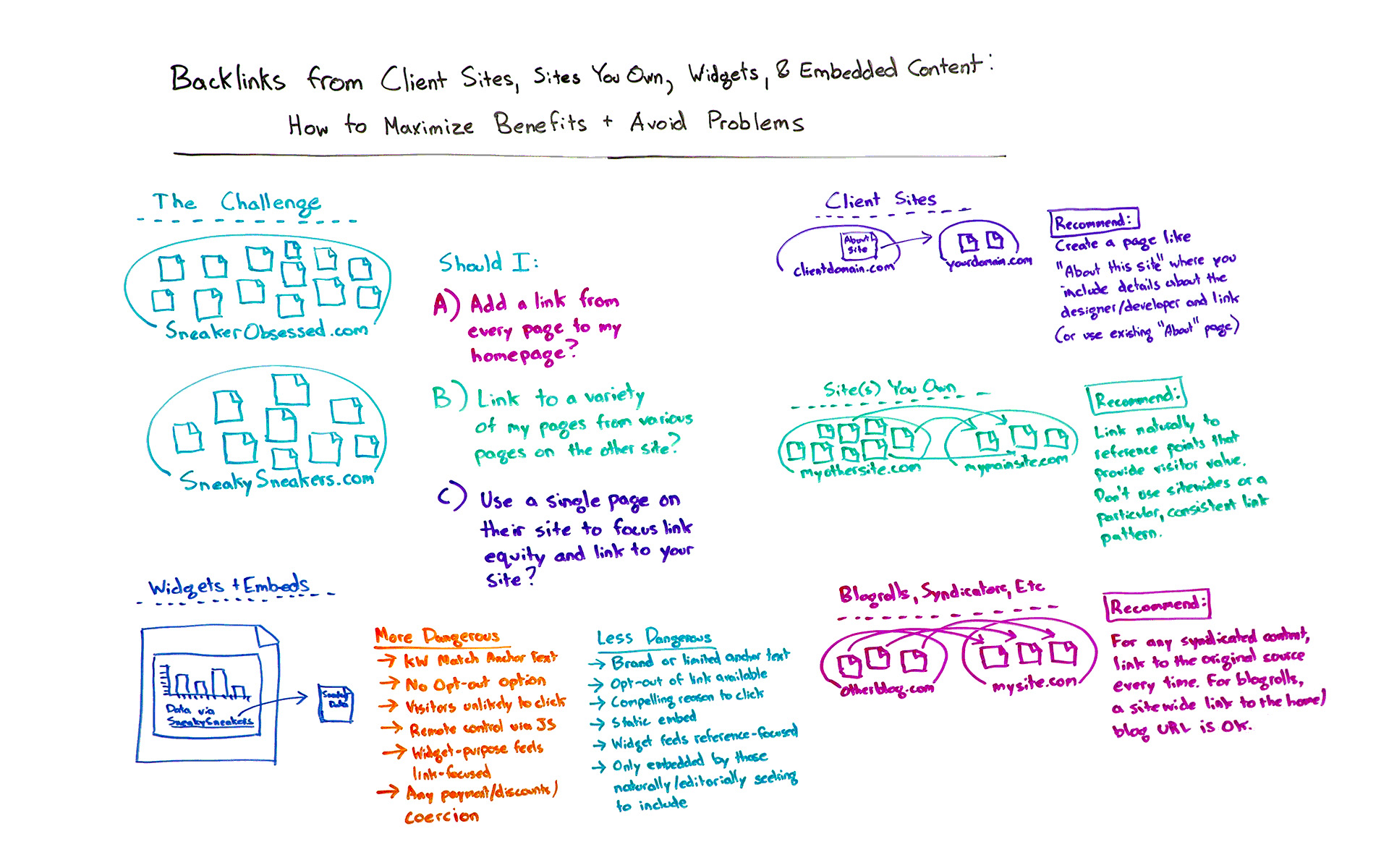
All right. The challenge here is let's say that I own sneakerobsessed.com, but it is not my primary website, or maybe it's a client's website. But I do own sneakysneakers.com, and I'm thinking to myself, "Gosh, you know the fact that I control, I have the login for the admin here, the site owner, or me, would be fine with linking from these pages to these pages. What should I do there? I don't want to get into trouble. But I would love to get some benefit, and I think that these links could help me. Should I:
A. Add a link from every page here to a bunch of pages here or to my homepage?
B. Should I link to a variety of my pages, like take a few of these and link them to my homepage, take a few others and link to some internal pages?
C. Should I use a single page on this website to link back to maybe my homepage?
The answer is kind of, it depends. It depends.
My recommendations
Client websites

If it is a client website or a site you've done work for, a site you designed or built, or your agency did, if you have clientdomain.com, what I'm going to suggest is that you
take a page, the About page or a page you specifically built like About This Site,
and you link to that page from the footer or the sidebar or the header. It's kind of one of those things that gets us linked to from a lot of pages. It's like the About page or the Contact page or the Privacy Policy, those kinds of things would get on clientdomain.com.
You make that the only page where you intentionally specifically link back to your domain. You essentially have some blurb about, "Here are the details about the designer or developer, the technologies used on this website," those kinds of things. "If you would like to get in touch with the creator of this website, it is these folks over here," and that points over to you. That means you essentially have a site-wide link to one page, which is flowing a lot of link equity to that single page on your client's website, and that link is pointing over to you. This is very unlikely to be penalized. It's very likely to draw in clicks. It has all these beneficial properties.
Site(s) you own

For sites that you own, so myothersite.com and mymainsite.com, what I'm going to suggest here is that you don't have an intentional specific link strategy like, "Okay, one out of three pages I'm going to have a link. I'm going to have them link to these pages in particular. I'm going to have the anchor text always be this." Don't set up that kind of policy or process. Instead, I want you to focus on
providing visitor value.
Reference things on your main site when they are relevant to content on your other site, and this should happen
naturally and organically.
Anytime you're referencing other content you've created or things that you've done, or recognition that you have, or someone else from your organization, you would naturally link over here. That's the way you should play it, not with some specific process and checklist. Anything that matches a very standard pattern is going to be easily recognized by Google, and that can get you into trouble.
Blogrolls, syndicators, etc.

With
blogrolls and
syndicators and those type of sites, it's a little less stringent, because blogrolls and syndicators have these unique attributes of basically saying it is the right thing to do for a blogroll when it exists usually on one of the sidebars of a blog, sometimes the blog's homepage, sometimes every page of a blog, it's usual for those to be kind of site-wide style links that always point back to the other blogs' websites' homepage or blog pages. That's okay here too. That is not a big problem.
The only time you get into real trouble is if that blogroll is essentially just a paid manipulation. It's technically a blog network. It's not that you're being editorially endorsed by someone else. They're only linking to you because you're linking to them. You get into that reciprocity challenge. That's not to say you should never link to anyone who has you in their blogroll either. It's just that this has to look natural and editorial to Google, or you can get in trouble.
Syndicators, by the way, it's okay to link from every syndicated piece of content back to the original piece of content. In fact, that's the way it should be. If you do your own syndication, like I do sometimes on Medium, where I put up my blog posts that I've already put on moz.com/rand on medium.com/randfish, then you should have each of those link back to their original pieces, and that's just fine.
Widgets & embeds

For widgets and embeds, things get a little dicier, and
this is actually where we see a ton of penalties. Not to say that people don't have problems with their client sites too a lot of the time, but widgets and embeds have been particularly taken to task by Google in the recent past.
So the idea here is that you have this piece of content here that's being embedded from your site. So Sneaker Obsessed, maybe the guys there went to Sneaky Sneakers. They saw a data graph of Nike shoes versus Adidas shoes sales over the last 12 months, and they were like, "Oh, man. I really want to show that. That's awesome." In fact, there's a little "embed this graph onto your own website." So they took that, and they put it on there.
More dangerous
You get into more dangerous territory with this type of thing when in the link between here there's:
- Keyword-matching anchor text
- No opt-out option, meaning there's no way to say, "I don't want to include the link to the original"
- When visitors are very unlikely to click that link; when there's no sort of, "Oh, why would I ever click on the attributed link from the embed?"
- Remotely controlled via JavaScript, meaning you can remotely update this link and anchor text, that gets real sketchy.
- Widget's purpose feels like it exists only for links, like it's not particularly useful, there's not a clear reason why this is a widget instead of just a graphic that other people can use or content they can syndicate, why make it a widget as opposed to something like a graph whose data can change, or an interactive content element, or a video player, or something like that?
- Any sort of payment or discounts that you offer or coercion to get people to embed it gets you into more dangerous territory.
Less dangerous
You're much less likely to have problems if you:
- Keep that anchor text branded or omitted entirely. It's non-branded anchor text. It's just your brand name, or it's very limited. It just says "Data Via," and via is the link itself.
- Opt-out of the link is available, meaning that someone could say, "Yeah, I want to embed that. Include a link back to sneakysneakers.com? No. No, thank you."
- There should be a compelling reason to click.
- That embed is static.
- It's not controlled by JavaScript.
- The widget feels like it's reference-focused, so there's actually some value there.
- Only embedded intentionally by those who are naturally and editorially choosing to include it.
That will keep you safe.
Hopefully, you will not encounter these problems. I think if you follow these rules, you'll be in the safe zone, and you'll also be benefiting from the link value that these can provide. I look forward to your comments. We'll see you again next week for another edition of Whiteboard Friday. Take care.
Video transcription by Speechpad.com
Sign up for The Moz Top 10, a semimonthly mailer updating you on the top ten hottest pieces of SEO news, tips, and rad links uncovered by the Moz team. Think of it as your exclusive digest of stuff you don't have time to hunt down but want to read!


 FetchRss